Cooking for family and friends is very satisfying however there is a certain degree of pressure to ensure everything is perfectly cooked & tastes fab. Thanksgiving, Christmas, Chanukah and other holidays require precision planning and none more so the star of the main course- the turkey. After lots of research – reading, chatting with chef friends & experimenting I have settled on this recipe with a few key steps & tips using a steam roasting method. Easy to prepare & always resulting in slices of succulent turkey that taste terrific, according to my guests!
Ingredients:
Serves 10 plus leftovers
•Turkey around 6 kg/ 13.2lb, cleaned, giblets removed, weigh & make a note (very important) .
•2 red onions peeled and roughly chopped
• 2 carrots peeled & chopped into discs
• 2 celery sticks, washed & roughly chopped
• 1 leek, washed & roughly chopped
• 6 cloves of garlic, left in the papery skins
• fresh herbs: rosemary ( 5 stalks), fresh thyme ( 6 stalks), fresh sage ( 5 leaves), 4 bay leaves, small handful of flat leaf parsley, washed
•30g unsalted butter or non dairy spread at room temperature
• 1 unwaxed lemon , cut into half, rind removed from 1 half
•1 teasp sweet smoked paprika
• sea salt & black pepper
• 250 ml/ 9 fl oz cold water
Method:
Ensure the turkey is at room temperature so remove from the fridge about 1.5 hours before preparing & cooking.
Heat the oven to 200C / 392F fan.
Put the chopped veggies, garlic, 3 bay leaves, 4 rosemary & 4 thyme stalks in the bottom of your roasting dish. These will act as trivet both protecting & adding flavour to the turkey. They will be used to make the gravy too.
Prepare the herb butter for the turkey breast. Finely chop the sage & mix with the softened butter, paprika, lemon rind , few grinds of sea salt & black pepper. Divide into 2 & flatten.
Season the turkey with sea salt & black pepper around the outside & in the cavity.
With the breast side up push your fingers carefully between the skin & each breast to create a pocket. Add the herbed butter and massage to cover each breast ( see video).
Put remaining bayleaf, rosemary & thyme, 1/2 lemon ( rind still on) & flat leaf parsley into the cavity.
Turkey prepared & ready to roast
Put the turkey on its side, add the water to the dish then cover with foil ensuring wrapped but with some room to allow for the steam to circulate.
Cook for 30 minutes at 200C / 392F then turn the oven down to 180C/356F fan.
Calculate the roasting time which will be 20 minutes per 500g/ 17.6 oz. E.g. a 6kg turkey will require 4 hours roasting time.
The key to a moist succulent turkey is to regularly baste the turkey, ideally every 30 minutes using a baster or spoon ( see video).
After 1 1/2 hours cooking remove the turkey and carefully turn over onto its other side using thick rubber gloves or meat prongs. Be careful as it will be hot! Re-cover with foil and continue roasting, basting every 30 minutes.
For the last 30 minutes roasting, take the turkey out and turn so it’s breast side up, remove the foil and put back into the oven to brown the skin to a golden bronze colour.
Remove from the oven & re-cover with foil, then a hand towel to rest for at least 1-1.5 hours. This tip is important to allow the juices back into the meat & ensures for easier carving. With a blanket of foil plus towel the turkey will keep warm.
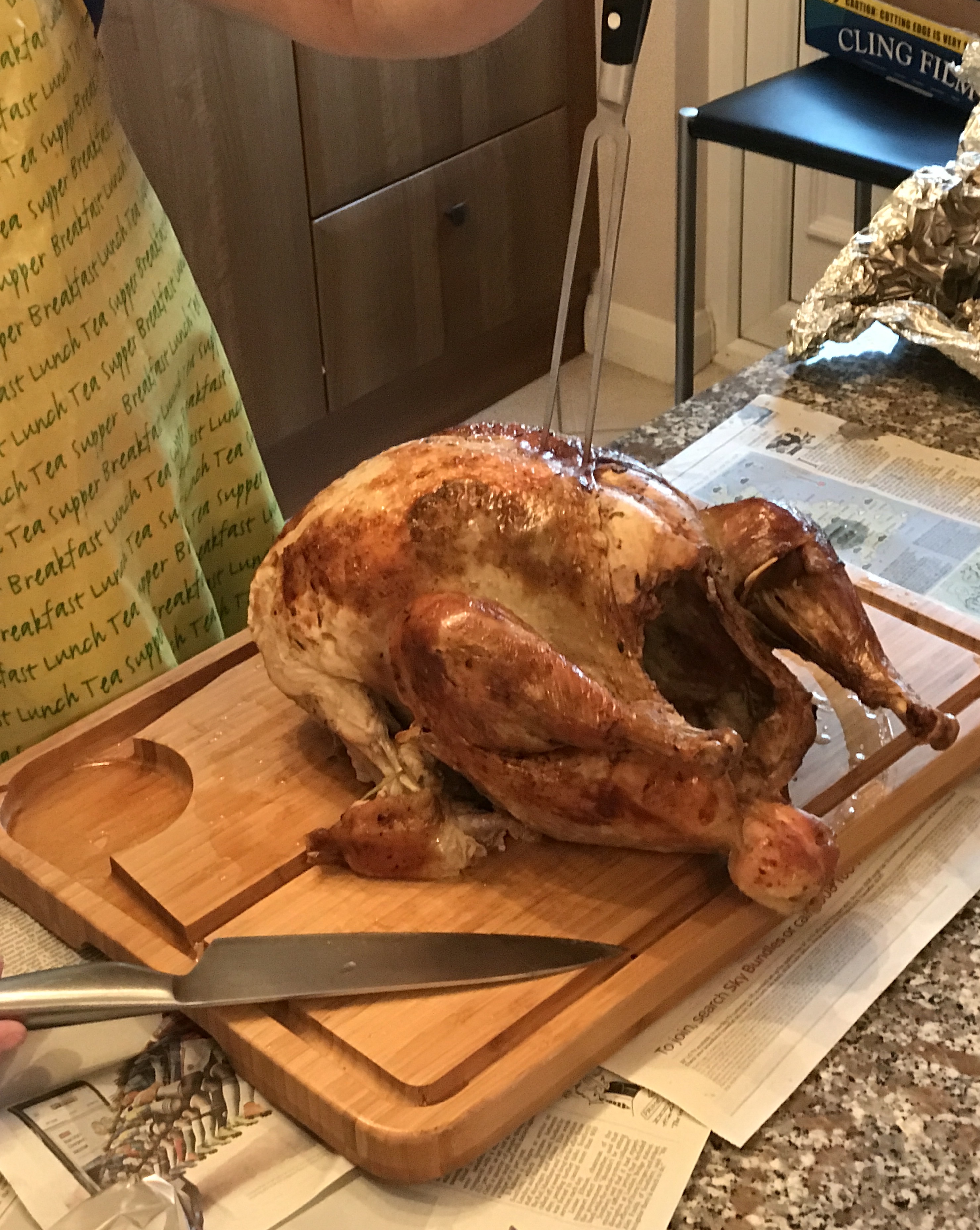
Roasted, rested & ready to carve
After resting carefully remove the turkey onto a meat board. I then separate the turkey juices from any fat in the roasting dish & push the roasted veg through a sieve. Combine in a pan adjust seasoning if needed and simmer to concentrate slightly. I add a desertspoon of redcurrent jelly & mix for a tasty turkey gravy.
Carve and enjoy along with chestnut, apple & thyme stuffing & roast potatoes (see recipes in our blog archives) and the home made gravy. I serve with braised red cabbage, carrots, roast parsnips, & roast brussel sprouts with pomegranates.
Food often evokes memories of family celebrations and none more so than Smoked Scottish Salmon
Growing up it was always served as part of our family and community gatherings, whether on bagels or mini bridge rolls (with or without cream cheese) alongside such delicacies as chopped herring and egg salad. It was a symbol that effort had been put into preparing something luxurious for everyone to enjoy
Today, Smoked Salmon (whether Scottish or other origin) has become a staple on the brunch menus of diners, cafes and restaurants in New York, London and beyond and is very easy to find in supermarkets
However, not all Smoked Salmon is born equal
The fact it has become such a common product means the art of creating a high quality, hand made, naturally preserved product has become lost, as mass production in large scale factory processes with artificial enhancements and additives have been introduced in the race to supply it to the expanding marketplace
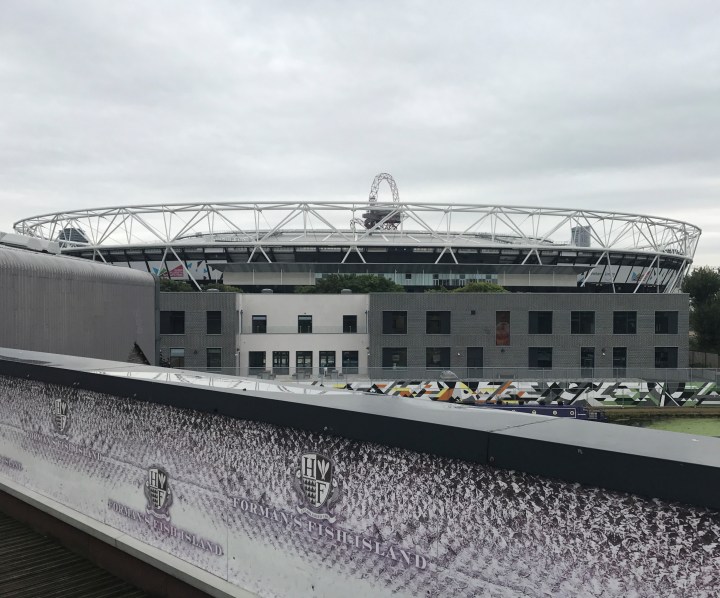
The London Stadium (home of West Ham United) viewed from H Forman & Son’s Factory
In search of the origins of Smoked Salmon, we recently had the opportunity to visit H Forman & Son to meet with Lance Forman, the head of this famous London based Smoked Salmon dynasty. Early one overcast London morning, we arrived at his family’s modern factory on the rather aptly named ‘Fish Island’ which boasts fantastic views of the 2012 Olympic Stadium and skyline
Lance is the 4th generation of his family business, which is now the only company preparing the style of smoked Salmon known as the ‘London Cure’ in East London In recognition of it’s uniqueness of production and region, in July 2017, H Forman & Son became the first London food company to be awarded European PGI (Protected status of Origin) for their London Cure Smoked Salmon. This is the same status as that held by luxury products like Champagne
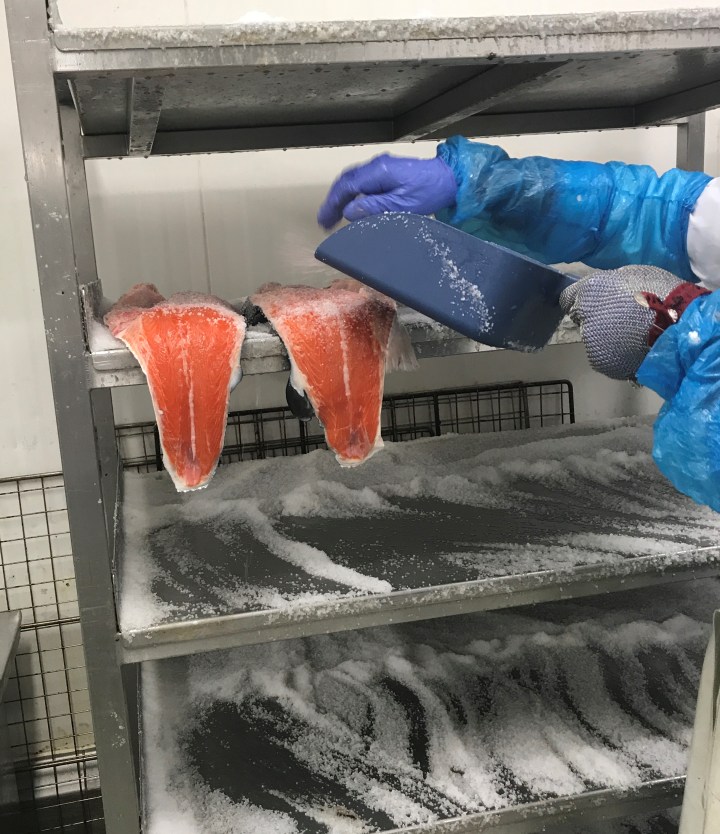
Salting the Salmon – one of the stages of the London Cure
According to Lance, the original business was set up by his great grandfather, Harry, in Stepney, East London in 1905 to provide traditional preserved salmon to Jewish refugees who had fled the pogroms in Russia and Eastern Europe at the turn of the 20th Century
At first, Harry followed the original Jewish method of preserving salmon by salting it and transporting it in wooden barrels shipped from the Baltic but then he made a discovery in Billingsgate Fish Market that would change everything. What he found was a fantastic quality salmon from a source much closer to home, i.e. Scotland. The taste was far superior to the imported salmon and the famous London cure Scottish Smoked salmon was born. The new product’s popularity grew and eventually led to Smoked Salmon becoming the global hit we are familiar with today
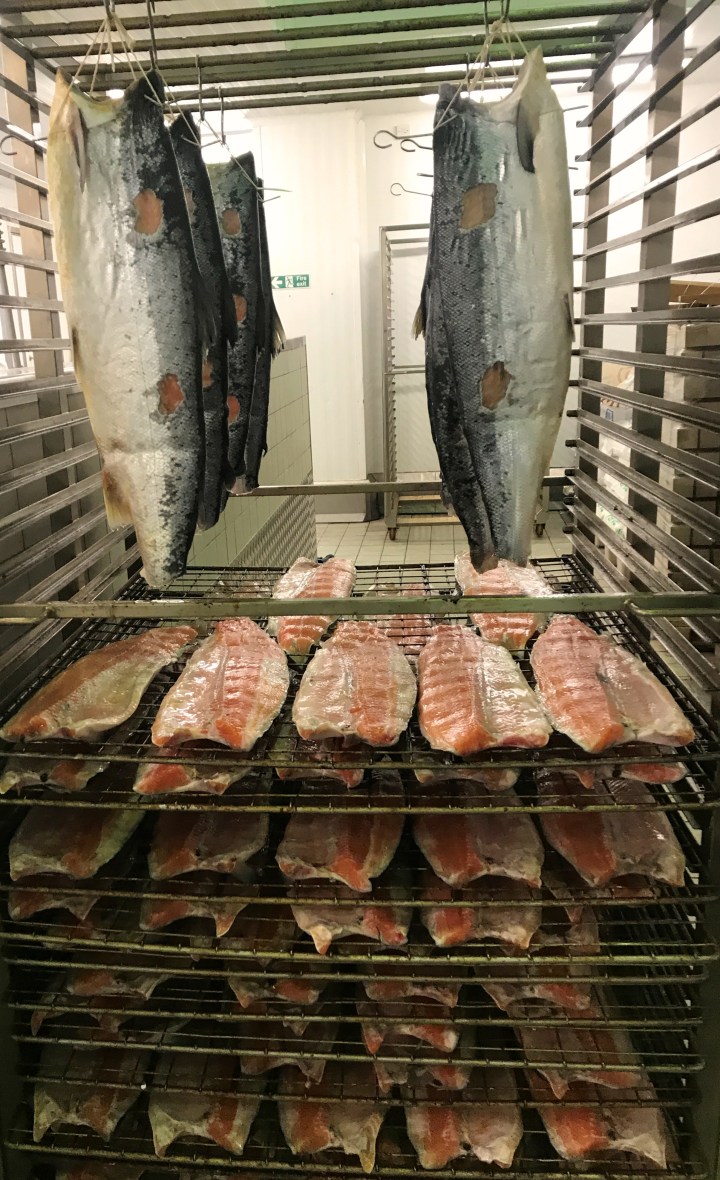
Salmon ready for Smoking
Lance takes great pride in his family tradition of producing the finest Smoked Scottish salmon and he gave us a fascinating explanation of the London cure process, as he took us on a tour of his factory:
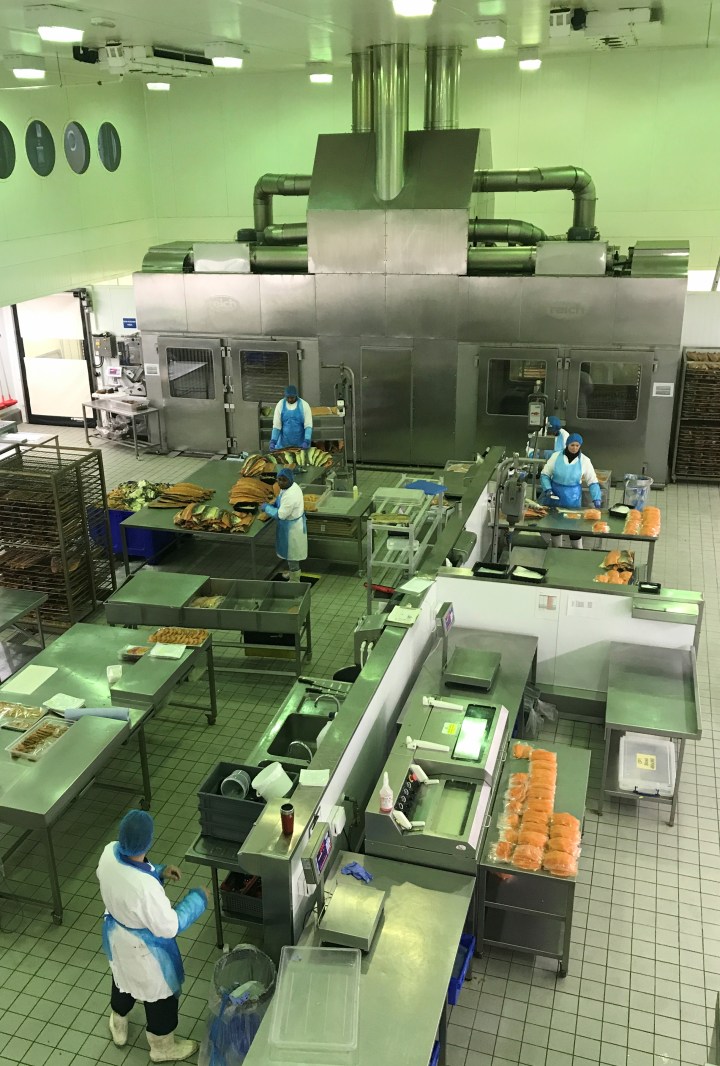
The first step in the process involves the fish being inspected. It is then cut in half and nicks are expertly cut to help draw out the moisture as part of the dry curing process. The sides are then laid on a bed of rock salt for a set period of time. They are then skewered and roped up to hang in the kiln for the cold smoking process.
Lance showed us the whole oak logs that are friction burned with accurate precision ensuring a consistently high quality method of providing smoke. Lance explained that other brands of ‘heavily smoked salmon’ are often brine injected and use the smoking process to mask the inferior quality of the salmon used. At H Forman & Son, the London cure and mild smoke just enhances the delicate taste and texture of the fish. Once cold smoking is finished the team remove the pin bones and expertly carve the product ready for packing
Bird’s eye view of H Forman & Son’s Smoked Salmon Process with the Smoker in the background
None of the fish goes to waste. ‘Off cuts’ are used to make pâté and the more heavily smoked outer layer or pellicle is used to make smoked salmon jerky
Whilst on site, we had the opportunity to watch a team of chefs at work at Forman & Field (the sister business) make a huge range of fish, seafood and meat premium foods and prepared dishes, perfect for entertaining and supplying food service, retail and online. These included a diverse range from pates and terrines to salmon coulibiac, dressed lobster and specialty cheeses to Beef Wellington
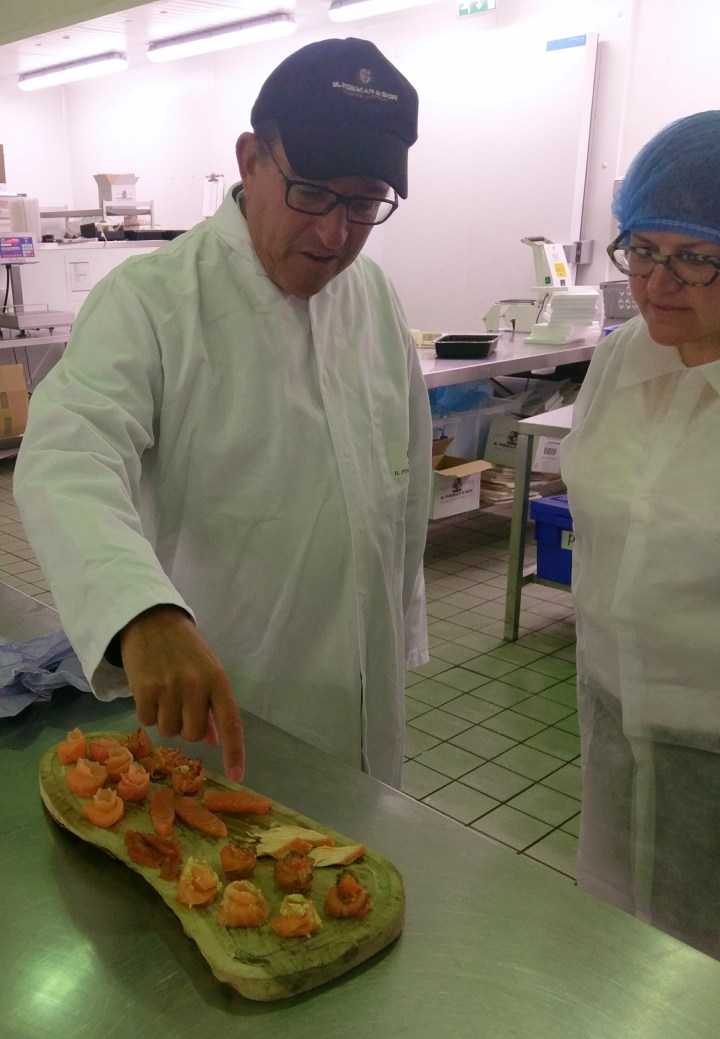
Lance explains to Lindsey the sample platter of London Cure Smoked Salmon
At the conclusion of our tour, Lance laid on a fantastic platter to showcase Formans wide range of cured salmon product. We tasted the Grade 1 standard Smoked Salmon product, wild Smoked Salmon (sourced by rod and line fishing from just one river in Scotland), gin & tonic cured salmon, gravadlax with dill, the royal filet ‘sashimi cut’ and last but not least, some salmon jerky. Our taste2taste favorite was the wild Smoked Salmon with its subtle flavor and amazing velvety texture that just ‘melted in the mouth’- simply delicious. Perhaps a tad expensive but we think well worth every penny!
The superb Smoked Salmon we sampled are all available online from the Forman & Field website (http://www.formanandfield.com) and in store at good supermarkets in the UK. The London cure smoked salmon is also available for online order in the USA at http://www.formansusa.com/ and for the information of our Jewish readers worldwide, it is a Kosher product, under the supervision of the London Beth Din
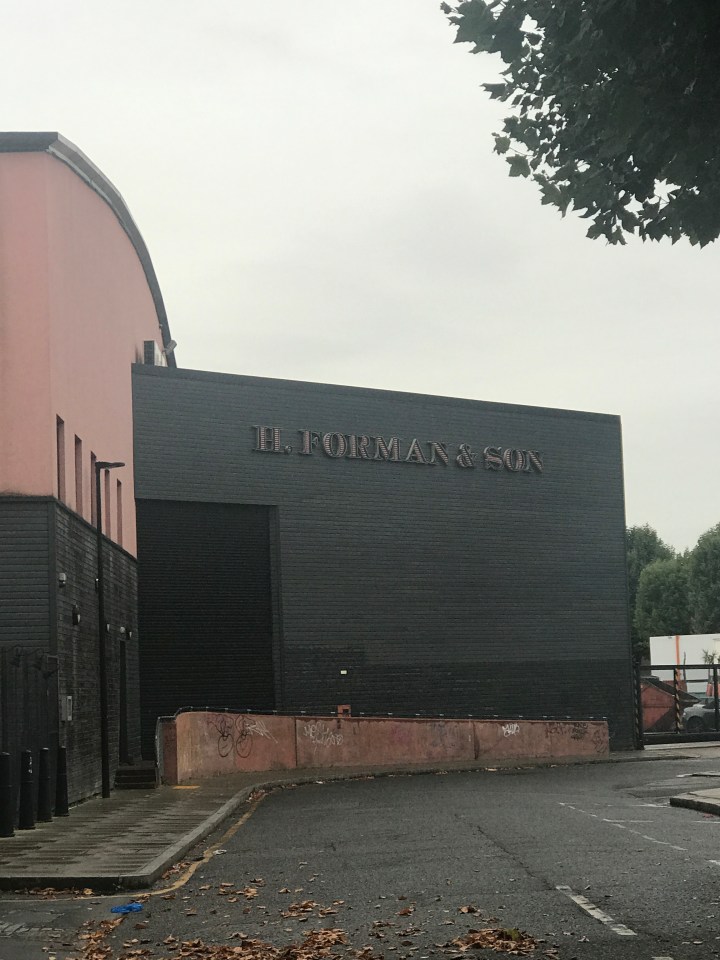
Exterior of H Forman & Sons factory
We had a great time meeting Lance and hearing about his family heritage of quality Smoked Salmon curing in East London and cannot wait to sample more of that wonderful London Cure at our future family and community celebrations as well as for brunch both in London and New York!
I had one of the best holidays earlier this year in Marrakesh, Morocco, a most inspiring, creative & magical place especially for a food blogger. I stayed at the Riad Les Trois Mages (The Three Kings) in the Medina, or old city.
Beautiful Courtyard at Riad Le Trois Mages
The historic house, has been beautifully restored by owners Anna & Tony, and run as a boutique Riad. We arrived by taxi, our driver expertly negotiating the ever narrowing streets & hustle bustle typical of morning life in the Medina. A heavy dark wooden door with cast iron studs, hinges, door knocker and the biggest lock suddenly opened and we were greeted with a welcoming broad smile by Aziz, the General Manager. Marian, an old friend has stayed there many times and we were immediately ushered through to the courtyard for a catch up on all the family & local news. It was an oasis of calm and tranquility away from the vibrant atmosphere of the Medina.
Saida the resident chef, prepared a delicious breakfast of freshly baked croissants, pancakes, fruit, jam and the first of many glasses of Moroccan mint tea, served in an antique silver teapot and expertly poured from a great height in a thin stream, with the minty aromas filling the air .
Breakfast in the Riad Les Trois Mages
The friendly Moroccan hospitality from Aziz, Saida, Mouhsin, and the rest of the team really made our stay incredibly special. Anything we needed from restaurant bookings, taxis, suggestions on places to visit to my personal guide of the souks was efficiently arranged, always with a friendly smile!
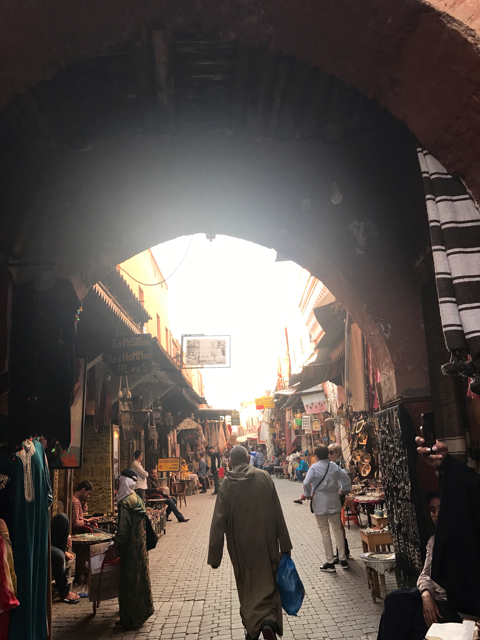
Meandering in the Medina
Marrakesh is a great place to meander, taking in the atmosphere and marvelling at all the artisans, who make and sell their wares. In the souks, expect a greeting from some of the shopkeepers, enticing you to look & hopefully buy. I did not feel it was intrusive, and was happy to partake in some friendly banter!
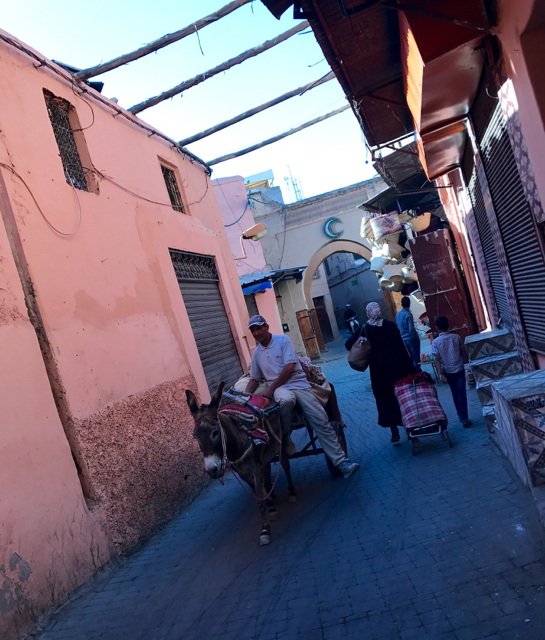
The narrow streets are busy, from the mopeds zipping past, to the locals, with their shopping trollies of goods, and carts pulled by hand or donkey. It is a cacophony of sights, sounds, smells & tastes, and the atmosphere & creative buzz is infectious.
Souk Life & Transport
By contrast there were many places to relax whether the Riad’s roof terrace & a quick dip in the small pool, in a local cafe or the gardens, hidden behind the ancient stone walls of the Red City. Aziz recommended Le Jardin Secret (Secret Garden), a mid 19th Century palace with both exotic & traditional Islamic botanical gardens. It opened last year after restoration by an award winning British garden designer, a team of Italian architects and expert local builders.
The Secret Garden revealed
I had a tour of the tower, from Jawad, the guide, who recounted its history, from the 16th Century when the Saadian Sultan built the original palace, whilst we climbed the steps up to a roof terrace and fantastic view of the city.
View of the Secret Garden from the Tower
I also visited the more well known botanical gardens – Jardin Majorelle, arriving early on Saturday morning, to miss the crowds. Originally the family home, artist studio & gardens of French artist Jacques Majorelle in 1930’s, it was discovered overgrown and in need of TLC by the fashion designer Yves Saint Laurent. Together with Pierre Bergé they bought & lovingly restored the buildings and gardens.
Jardin Majorelle
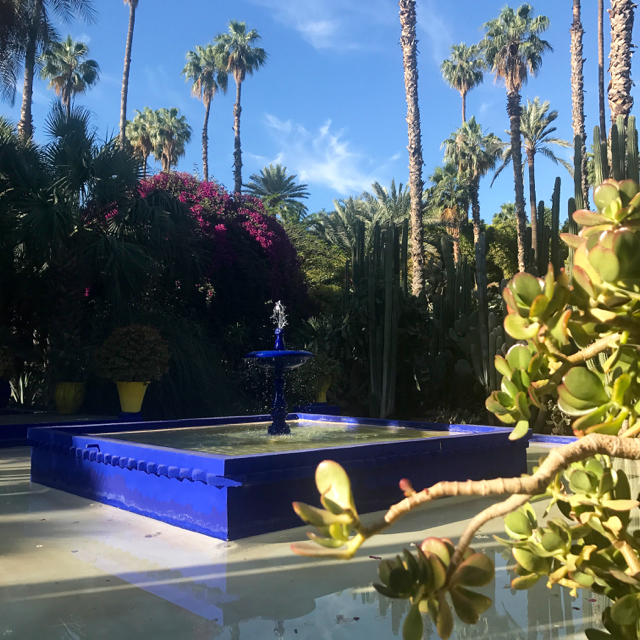
I walked around looking through the palm trees up to the vibrant blue sky that matched the famous “Majorelle blue’ painted villa & fountains.
Fountain at Jardin Majorelle
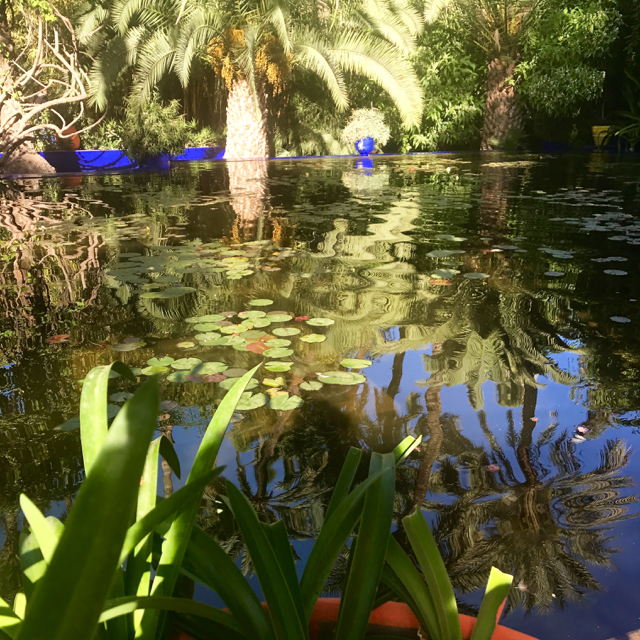
Reflections
I sat listening to the birdsong and the gentle lapping sounds of the water – a place of calm serenity and quiet reflection – magical! So what about the food? Marrakesh is a must for foodies and the cuisine has many influences including Arabic, Berber, North African, Jewish, & Mediterranean – especially French & Spanish ( from Andalusia in the South). The Moroccan approach to food is everything home grown, freshly picked, bought daily from the Souks or markets & cooked. Fruits, vegetables, eggs, meat, poultry, breads – prepared with an amazing array of herbs and spices. The aromas, layers of flavours & textures are a wonderful assault on your senses in a profound way – I’m a big fan! We ate incredibly well, with four stand out meals in particular.
Firstly Saida’s wonderful lunch of meatball & egg tagine and marinated chicken skewers with couscous- you will have to visit to taste for yourself! Secondly, dinner at the Cafe Arabe on the roof terrace, which was as much about the view and atmosphere as the food.
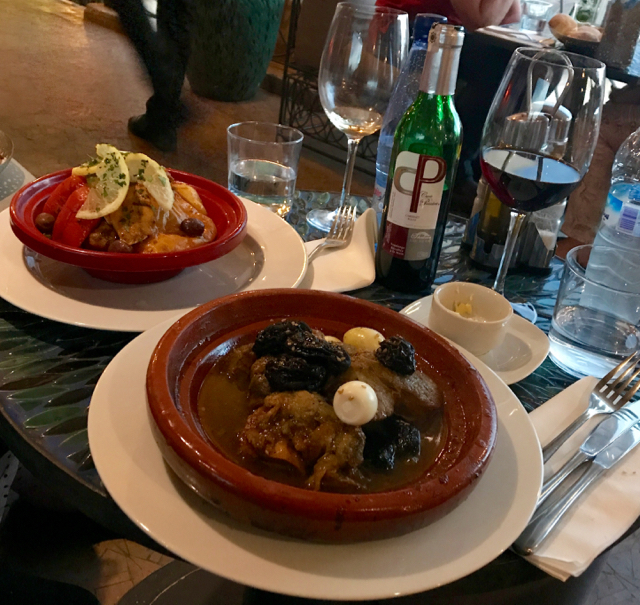
Tagines at Cafe Arabe
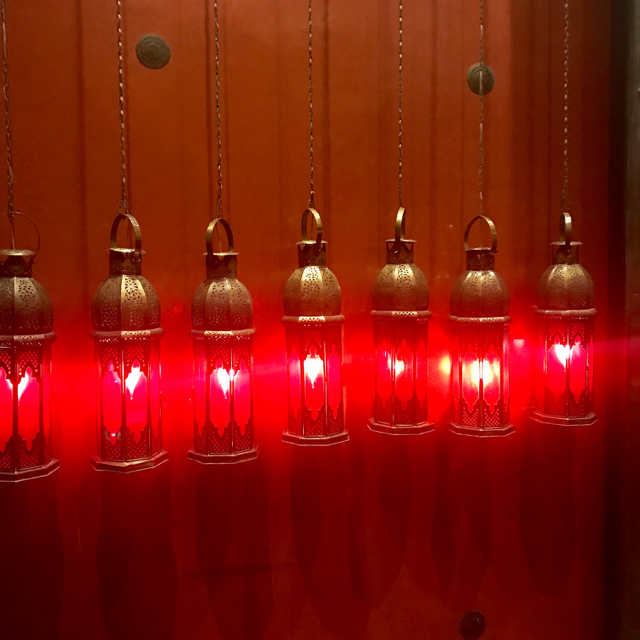
Lanterns at the entrance to Cafe Arabe
We had a delicious lamb and fish tagine and a glass of red wine being one of the few places that serve alcohol. There was a buzzy, relaxed atmosphere watching the sun set listening to the call to prayer from the muezzin. There were 3 mosques nearby and it sounded slightly competitive as to who could call the loudest, summoning the locals to prayer! The third restaurant, Latitude 31, a short walk from the Riad came highly recommended by Anna & Tony and we were not disappointed.
Latitude 31
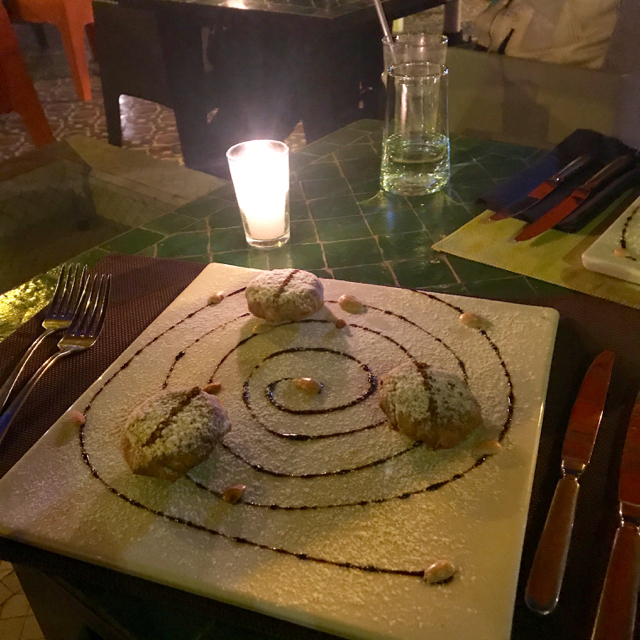
A common theme , entering through a large wooden door, this time through a narrow stone passage following the lantern lights & through a second door which opened out to reveal a beautiful open air courtyard lit by more lanterns – very romantic! We started with some freshly squeezed juice combos as there is no alcohol served. They tasted refreshing and a perfect start to a fantastic meal cooked by Redoin the chef and his team. We were expertly guided through the menu by Yassin, who bought us a trio of amuse bouche of a spinach parcel filled with local cheese, pumpkin crème brûlée & a croustillade (pastry case) filled with tuna whilst we decided what to choose. I had the trio of coquette pastillas with almonds, traditional sweet & savoury chicken filled pastries dusted with cinnamon & icing sugar- delish!
Trio of Coquelet Pastillas with Almonds
We had a vegetarian tagine and a speciality of Marrakesh – a Tangia Marrakchia – beef slow cooked (traditionally in an urn shaped terracotta pot) with onions, garlic, cumin, ginger, saffron, preserved lemon, smen (Moroccan preserved butter) and then seasoned with the famous spice mix -Ras el Hanout. The aromas were amazing as the tagine lids revealed the dishes. The tangia with its tantalising flavours- complex yet blending so well- savouriness with a slight sweetness and piquancy from the preserved lemon – fabulous! We opted for the recommended chocolate delight – a solid sphere hiding some velvety ice cream – watch the video for the full experience!
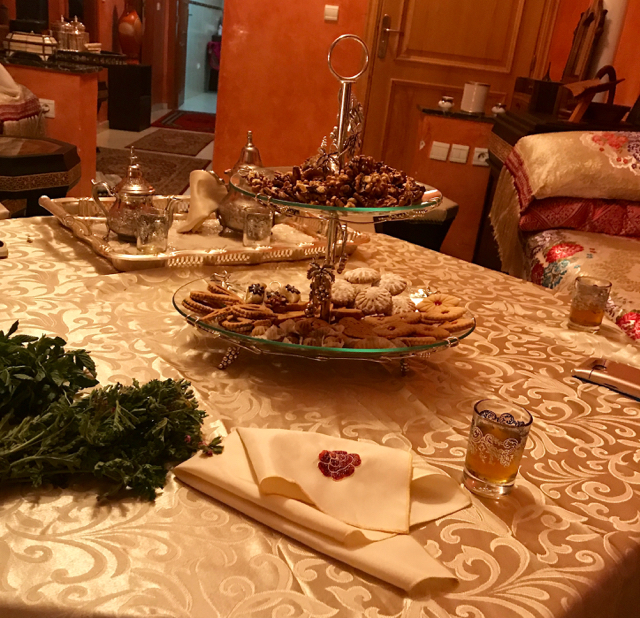
The last meal, and the most special, was at Aziz & his wife Atika’s home – an authentic Moroccan experience. We sat in their sumptuously decorated Moroccan salon, with beautifully carved furniture hand crafted by Atika’s family.
Amazing Moroccan Salon & Hospitality
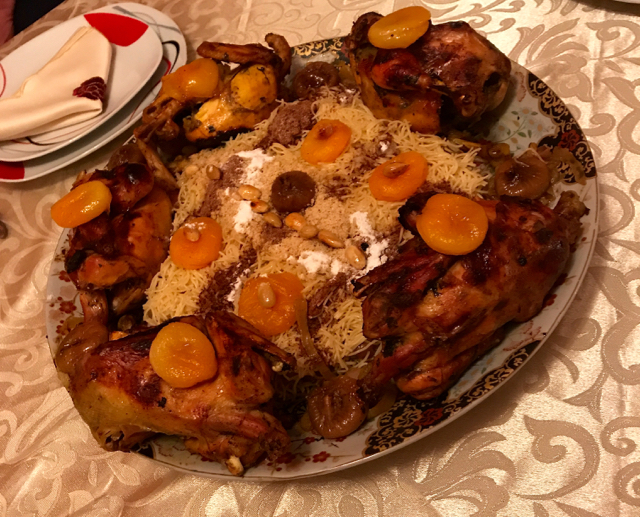
We had a wonderful meal of Seffa – chicken with vermicelli, an onion sauce with almonds, apricots, figs, raisins, decorated with a sprinkling of cinnamon.
Seffa – Sweet & Savoury Chicken vermicelli
It is a celebratory dish often eaten at festivals- and a combo of flavourful succulent meat with the vermicelli absorbing all the sweet and savoury flavours that typify Moroccan cuisine – delish! There was lively conversation and an opportunity to practise my basic French. We finished with a herb tea- expertly blended and prepared by Aziz – a refreshing end to a gorgeous meal. A holiday highlight was a 3.5 hour tour of the souks – with personal guide Mohammed Tabalqait. He came highly recommended by Marian & now by me – do not go elsewhere for a bespoke tour catering to your personal interests- interesting, informative & insightful!
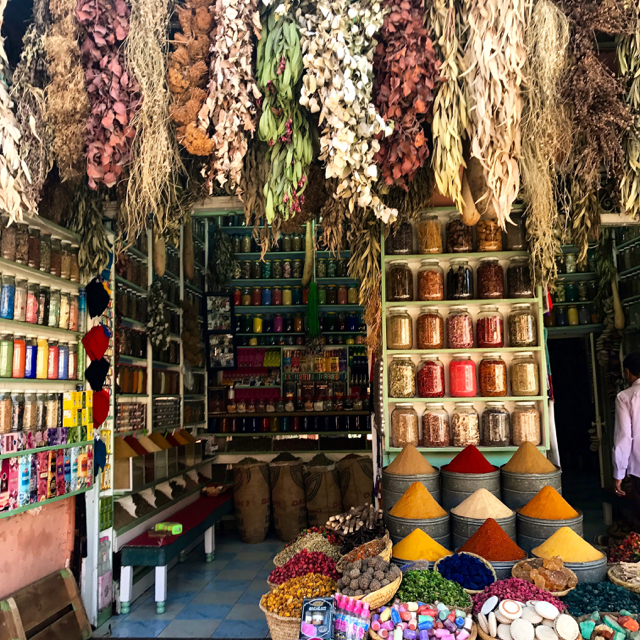
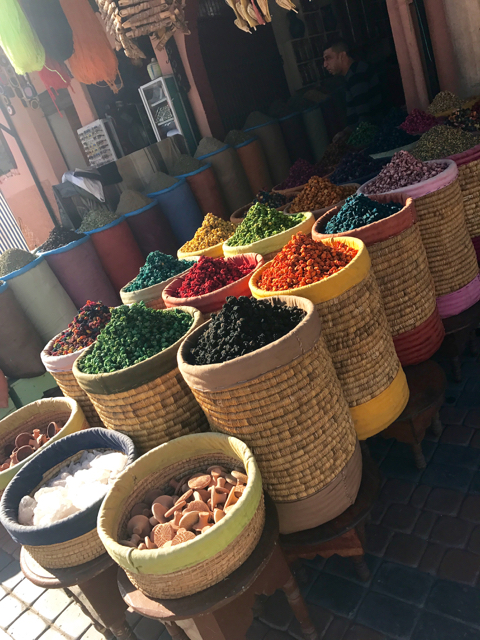
Dried flowers herbs & spices in the Souk
As a foodie , Mohammed expertly guided me round with history, stories, and a heavy focus on food and the other crafts hand made in the different souks. We were offered to eat breakfast with the lock makers – Bissara – a breakfast soup of fava/ broadbeans slowly cooked in a terracotta urn with a sprinkling of cumin, & drizzle of olive oil and eaten with barley bread. I thought Mohammed knew them – but he didn’t. A kind act of humble artisans sharing their food with strangers that was very touching. Rather than describe the souk experience I will let the photos do the talking!
Olives of many varieties
Handmade locks in the Souk
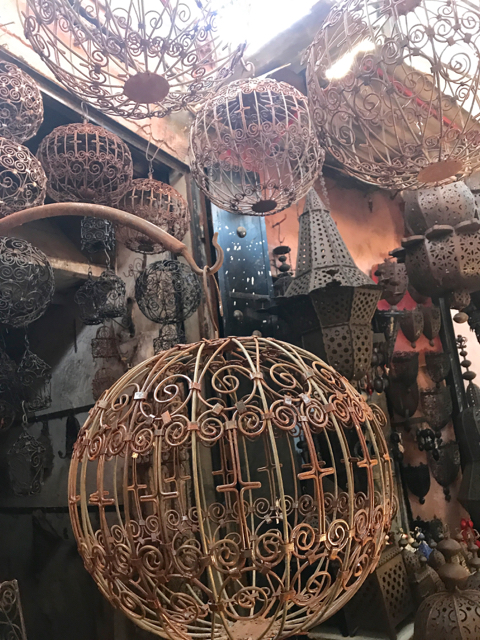
Hand crafted Lanterns in the Souk
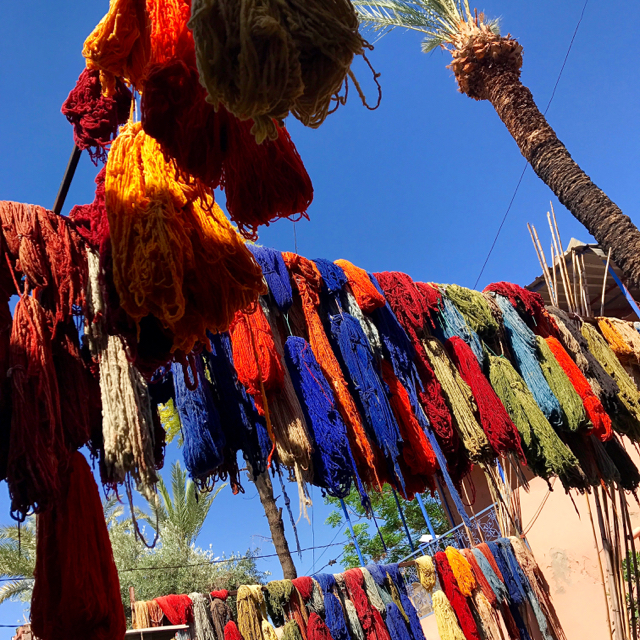
Dyed wool drying in the sun
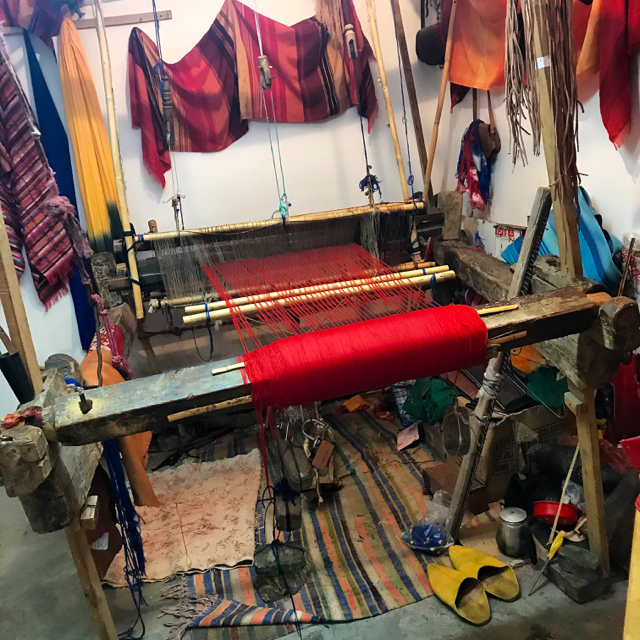
Weavers Workshop in the Souk
There are so many memories that have left a lasting impression – especially the people I met – now friends. I will definitely be returning to magical Marrakesh hopefully soon.


 Put the chopped veggies, garlic, 3 bay leaves, 4 rosemary & 4 thyme stalks in the bottom of your roasting dish. These will act as trivet both protecting & adding flavour to the turkey. They will be used to make the gravy too.











 taste2taste